

Back Pain After a Car Accident? What to Do, What ICBC Covers, and How to Actually Recover
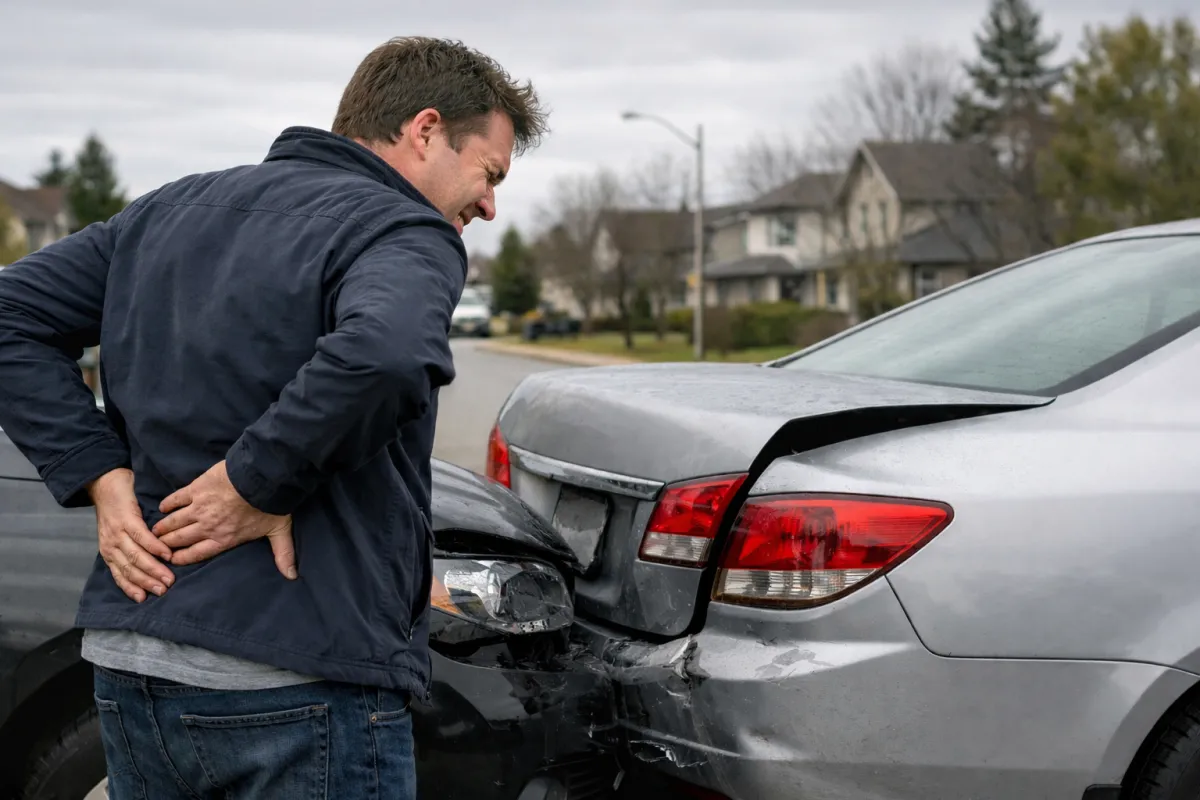
Here’s a scenario that plays out in Surrey more often than anyone would like. You’re driving down King George or sitting at a red light on 152nd, and someone hits you from behind. Maybe it was low speed. Maybe it was fast enough to deploy the airbags. Either way, your car is damaged, your day is ruined, and within the next 24 to 72 hours, your back starts hurting in ways it never has before.
And then the confusion begins.
Do you go to the ER? Your family doctor? A walk-in clinic? Should you be icing or heating? Can you still work out? Is ICBC going to cover treatment? How long is this going to last? Is this normal?
Most people have never been in a car accident before, and suddenly they’re expected to navigate a recovery process, an insurance claim, and their own pain all at once. It’s overwhelming. And what usually happens is that people either do too little too late, or they get stuck in a loop of painkillers and rest without actually addressing the injury.
We treat car accident injuries at Surge Wellness in Surrey every single week. It’s one of the most common reasons people walk through our doors. And the number one thing I wish more people knew? The first 12 weeks after your accident are the most critical window for recovery. What you do during that window can be the difference between a full recovery and chronic pain that follows you for years.
Let’s break this down. What’s actually happening to your back after a car accident, what ICBC will cover, what treatment looks like, and how to give yourself the best possible shot at getting back to normal.

Why Back Pain After a Car Accident Is Different From Regular Back Pain
This is important to understand right from the start. The back pain you get after a car accident is not the same thing as the back pain you might get from sitting at a desk too long or lifting something awkwardly. The mechanism of injury is completely different, and that changes how it needs to be treated.
In a car accident, particularly a rear-end collision, your body experiences a sudden, violent force that it was not prepared for. Your spine is compressed, extended, and sometimes twisted in a fraction of a second. The muscles, ligaments, and joints that normally protect your back are overwhelmed because the impact happens faster than your body’s protective reflexes can engage.
That’s why even a low-speed collision at 15 or 20 km/h can cause real injury. People often dismiss minor accidents because the car looks fine, but your body is not a bumper. Soft tissue damage, joint irritation, disc compression, and nerve inflammation can all occur without a single visible mark on your body.
The other thing that makes accident-related back pain tricky is the delayed onset. A lot of people walk away from a crash feeling okay, maybe a bit shaken, and assume they’re fine. Then two or three days later, the stiffness starts. The aching deepens. And by the end of the first week, they can barely bend over to tie their shoes.
This delayed response is normal. It’s caused by inflammation building up in the injured tissues, your muscles going into protective spasm, and your nervous system ramping up its pain signals. But because the pain didn’t show up immediately, a lot of people second-guess whether it’s really connected to the accident. It almost always is.
The Most Common Back Injuries We See After Car Accidents
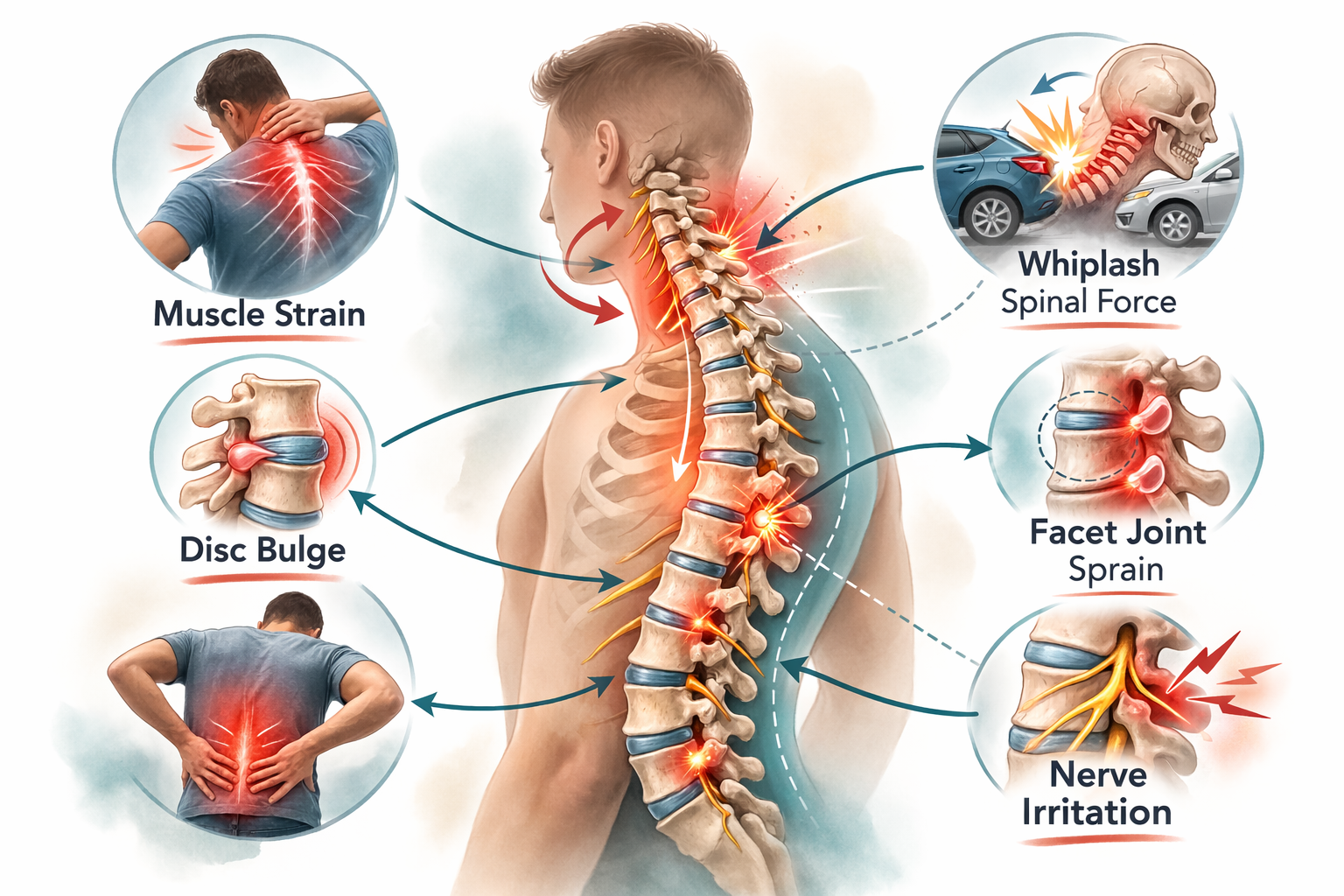
Not every car accident injury is the same, and back pain after a crash can come from several different sources. Here are the ones we treat most frequently at our clinic.
1. Muscle Strains and Soft Tissue Injuries
This is the most common category. The impact causes your back muscles to stretch beyond their normal range, creating micro-tears in the muscle fibres and surrounding connective tissue. You’ll typically feel deep, widespread aching, stiffness, and difficulty with movements like bending, twisting, or getting up from a chair.
Soft tissue injuries are sometimes dismissed as "just a strain," but they can be surprisingly debilitating and, if left untreated, can lead to chronic muscle tightness and compensatory movement patterns that persist long after the initial injury has healed.
2. Whiplash-Related Back Pain
Most people associate whiplash with the neck, and that’s fair. But the same whipping motion that injures the cervical spine also sends force through the entire spinal column. It’s extremely common to develop mid-back and lower back pain alongside whiplash, especially from rear-end collisions.
The thoracic spine (mid-back) and lumbar spine (lower back) can both be affected by the sudden flexion-extension forces of a crash. We regularly see patients whose neck pain receives all the attention, while their back pain is overlooked. Both need treatment.
3. Disc Injuries (Bulging or Herniated Discs)
The compressive force of a collision can push the intervertebral discs beyond their normal limits. A bulging disc might not cause immediate symptoms, but as the inflammation builds, it can start pressing on nearby nerves and cause radiating pain into the legs, similar to sciatica.
Disc injuries from car accidents can range from mild to severe, and the approach to treatment varies accordingly. The good news is that many disc issues respond well to physiotherapy and conservative management. The bad news is that ignoring them almost always makes them worse.
4. Facet Joint Sprains
The facet joints are small joints on either side of each vertebra that guide spinal movement. In a collision, these joints can be sprained or irritated, leading to sharp, localized pain that gets worse with extension (leaning back) or rotation. This type of injury often gets misdiagnosed or overlooked because it doesn’t always show up on imaging. A hands-on assessment by a physiotherapist is usually the most reliable way to identify it.
5. Nerve Irritation and Radiculopathy
If your back pain after a car accident comes with shooting pain, numbness, or tingling down one or both legs, there’s likely a nerve component involved. This can happen from disc herniation pressing on a nerve root, from swelling in the spinal canal, or from irritation to the nerves as they exit the spine.
Nerve symptoms should always be assessed early. They’re treatable, but the longer they persist without intervention, the more sensitized the nerve pathway becomes and the harder it is to calm things down.
The First 12 Weeks: Why This Window Matters So Much
I cannot stress this enough. The first 12 weeks after your car accident are the most important period for your recovery. And this isn’t just my opinion. It’s baked into how ICBC structures their coverage, and it’s backed by the research on soft tissue healing timelines.
Here’s why that window is critical.
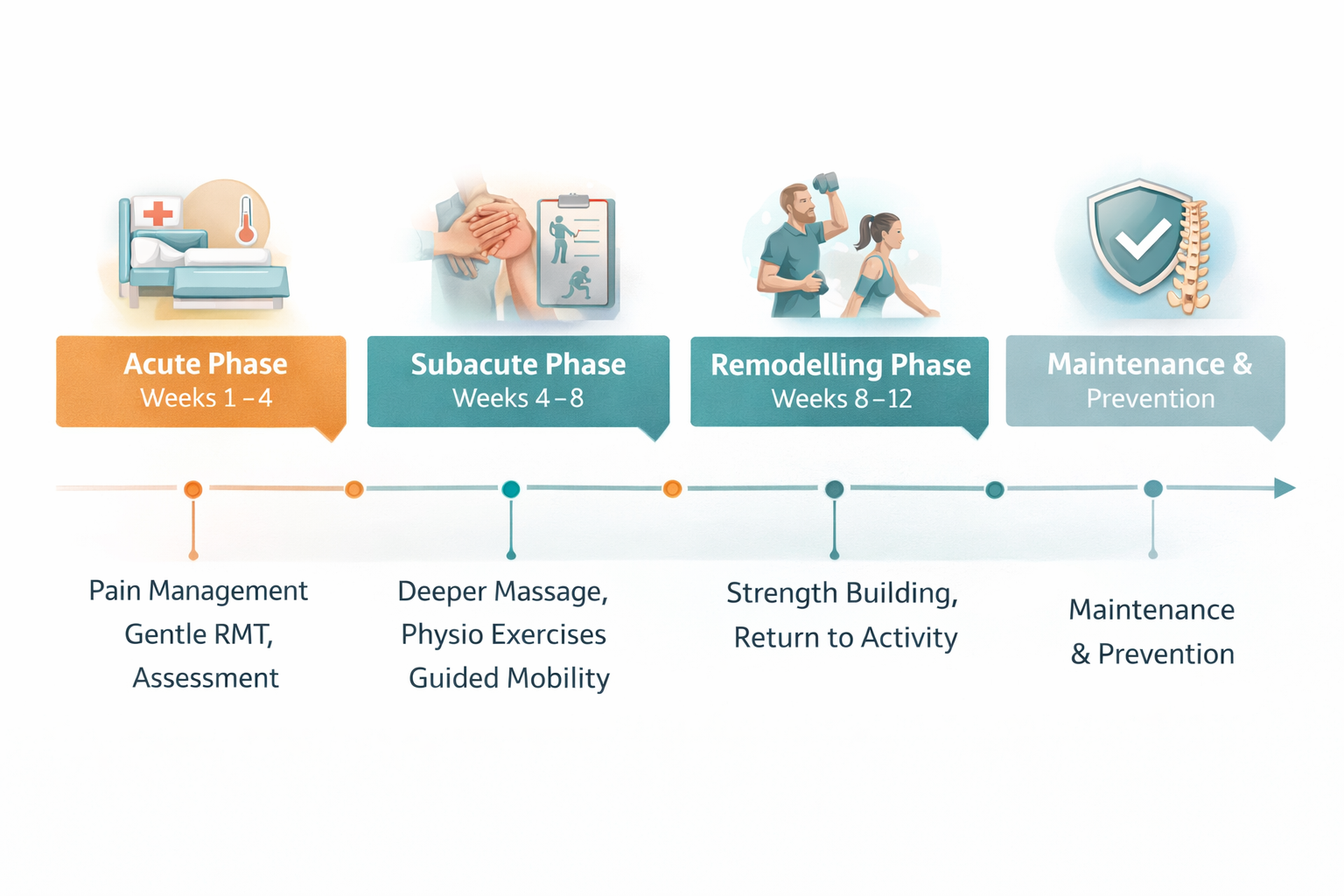
Soft tissue injuries like muscle strains, ligament sprains, and joint irritation follow a predictable healing timeline. During the first few weeks, your body is in the acute inflammatory phase. This is when the tissue is actively inflamed, swollen, and very reactive. After that, you enter the repair phase, where new tissue is being laid down. And then comes the remodelling phase, where that new tissue strengthens and organizes itself.
If you don’t start treatment during these early phases, several things go wrong. Your muscles tighten into protective patterns and get stuck there. The new tissue that forms doesn’t align properly, creating adhesions and scar tissue. Your movement patterns become guarded and compensatory. And your nervous system starts treating those abnormal patterns as the new normal.
By the time someone finally seeks treatment six months or a year after an accident, we’re not just dealing with the original injury anymore. We’re dealing with layers of compensation, chronic muscle tightness, joint restriction, and often a pain experience that’s become amplified by the nervous system. It’s still fixable, but it takes significantly more time and effort.
The people who start physiotherapy and massage therapy within the first two to three weeks after their accident consistently recover faster and more completely than those who wait. I’ve seen this pattern play out hundreds of times. It’s not even close.
What ICBC Actually Covers (And How to Access It)
One of the biggest barriers to recovery is confusion about the ICBC claims process. People don’t know what’s covered, they’re not sure how to start, and sometimes they delay treatment because they’re waiting for paperwork that doesn’t need to come first.
Let me clear this up.
You Don’t Need a Doctor’s Referral to Start
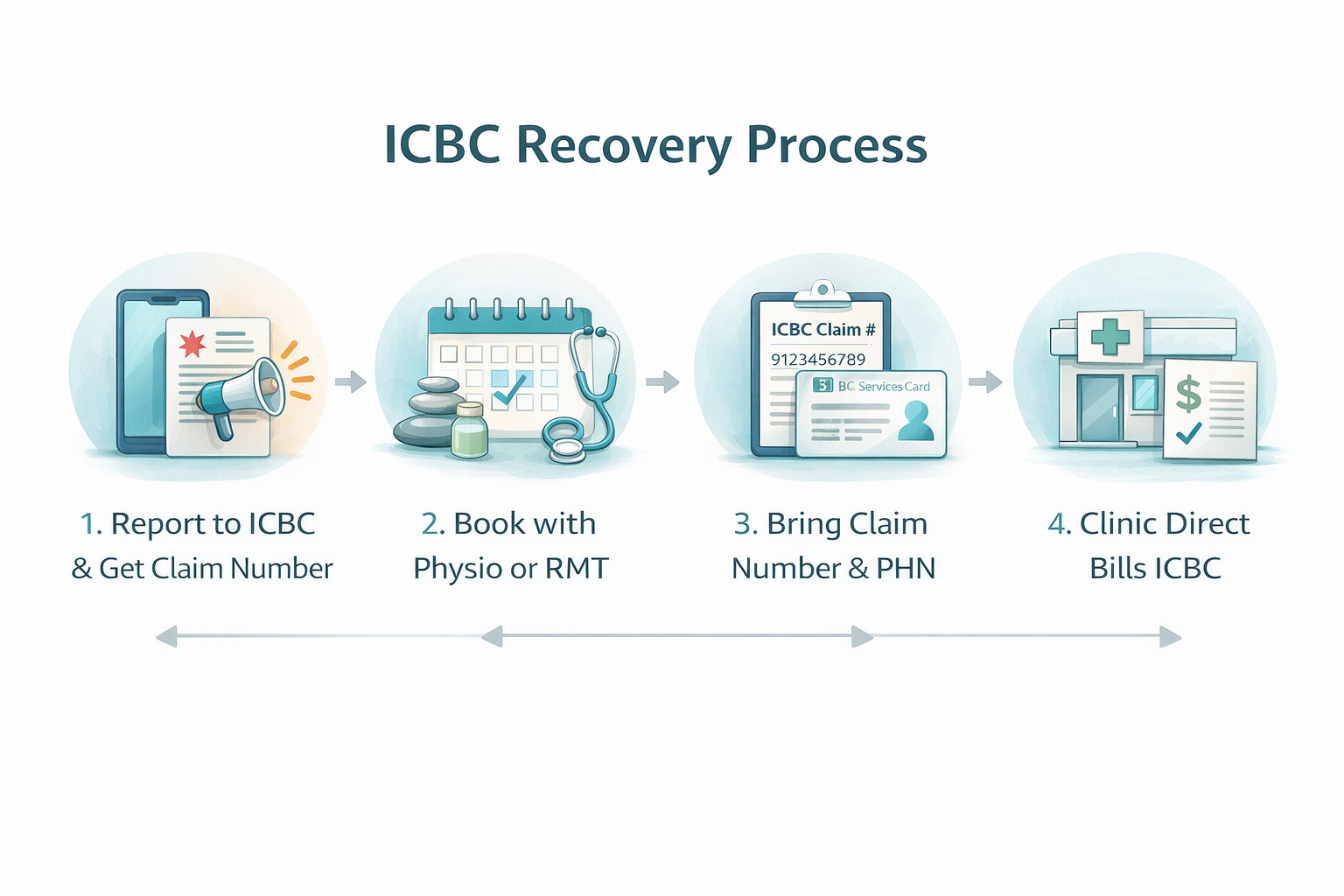
Under ICBC’s Enhanced Care model (introduced in 2021), you can go directly to a physiotherapist or registered massage therapist without a referral from your family doctor. You just need your ICBC claim number and your Personal Health Number (PHN). That’s it.
This is a huge deal because getting a doctor’s appointment in Surrey can take days or even weeks, and waiting for a referral means losing valuable treatment time during that critical early window.
Pre-Approved Coverage in the First 12 Weeks
ICBC pre-approves treatment for the first 12 weeks after your crash. For physiotherapy, this typically means up to 25 sessions. Massage therapy is also included in the pre-approved coverage. You don’t need prior authorization from ICBC for these initial sessions. You just book and start.
If your recovery needs extend beyond 12 weeks, your treatment provider can request additional sessions with supporting clinical notes. ICBC evaluates these on a case-by-case basis.
Fault Doesn’t Matter
This trips people up all the time. Under Enhanced Care, you’re covered regardless of who caused the accident. Even if you were at fault, even if you were a passenger, even if you were a pedestrian or cyclist involved in a motor vehicle collision. If you were injured in a crash in BC, you’re eligible for benefits.
Direct Billing Means No Out-of-Pocket Cost
At Surge Wellness, we direct bill ICBC. That means you don’t pay anything upfront for your approved treatments. You show up, you get treated, we handle the billing with ICBC. Simple.
I mention this because a surprising number of people assume they’ll have to pay and get reimbursed later, which makes them hesitate. You don’t. If your claim is active and the treatment is approved, there’s no cost to you.
How Massage Therapy Helps You Recover After a Car Accident
After a crash, your muscles go into overdrive. They tighten, they guard, they spasm. It’s a protective response, and it’s completely normal. But when that guarding doesn’t resolve on its own, it becomes part of the problem.
That’s where registered massage therapy makes a real difference.
An RMT who’s experienced with motor vehicle injuries isn’t going to give you a generic relaxation massage. They’re going to assess which muscles are in spasm, where the adhesions are forming, and how the injury has affected your movement. Then they’ll use targeted techniques to address those specific problems.
For back pain after a car accident, RMT treatment typically focuses on:
Releasing the paraspinal muscles that have gone into protective spasm along both sides of the spine
Working through the quadratus lumborum (QL), a deep muscle that often locks up after impact and refers pain into the hip and low back
Addressing the thoracolumbar fascia, a large sheet of connective tissue that can become restricted and limit your ability to bend and twist
Treating the hip flexors and glutes, which commonly tighten up after a crash as your body braces against further injury
Calming the nervous system, because your fight-or-flight response can stay activated for weeks after a traumatic event, and that keeps your muscles locked in a tense, painful state
The timing matters here. In the acute phase (first 2 to 4 weeks), massage therapy needs to be gentler and more focused on reducing spasm and improving circulation to the injured area. As you move into the subacute and chronic phases, the RMT can work more deeply to break up adhesions and restore full mobility.
We had a patient earlier this year, a delivery driver who was rear-ended on Highway 10. He came in about a week after the accident with severe muscle guarding through his entire lower back and mid-back. After six RMT sessions over three weeks, he went from barely being able to sit in his truck to completing full shifts again. He still needed physio to build back his strength and stability, but the massage was what got him out of that initial crisis.
How Physiotherapy Rebuilds What the Accident Broke Down
If massage therapy is the fire extinguisher, physiotherapy is the rebuild.
After a car accident, your body doesn’t just need pain relief. It needs to relearn how to move properly. The impact disrupts your movement patterns, weakens the stabilizing muscles around your spine, and creates joint restrictions that limit your range of motion. Physiotherapy addresses all of that.
A physiotherapy plan for car accident back pain at Surge Wellness typically includes:
Thorough initial assessment: understanding exactly which structures were injured, how your movement has changed, and where the restrictions are
Manual therapy: joint mobilizations to restore movement in the lumbar and thoracic spine, especially facet joints that have stiffened post-impact
Graded exercise therapy: starting with gentle mobility work and progressively building toward strength and stability exercises as your tissue heals
Core reactivation: your deep core muscles often shut down after a traumatic injury. They need to be specifically retrained, not just stretched
Neuromuscular re-education: helping your body unlearn the guarded, compensatory movement patterns it adopted after the crash
Education: understanding your injury, your healing timeline, and what you should and shouldn’t be doing at home
One thing I feel strongly about: if someone tells you to just rest after a car accident, please get a second opinion. Prolonged rest for musculoskeletal injuries is outdated advice. The research consistently shows that early, guided movement leads to better outcomes than extended bed rest. Rest might feel right in the first few days, but beyond that, your body needs movement to heal properly. The key is the right type of movement, at the right time, guided by someone who knows what they’re doing.
RMT and Physio Together: Why Both Matter After a Crash
You might be wondering whether you need massage therapy, physiotherapy, or both. And for car accident injuries, my answer is almost always both.
Here’s how they work together in practice.
In the early weeks after the accident, massage therapy takes the lead. It brings down the acute muscle guarding, reduces pain levels, and restores enough mobility for you to actually participate in rehabilitation exercises. If you’re too locked up to move, you can’t do physio effectively. Massage gets you to that starting point.
Once your pain is more manageable, physiotherapy ramps up. This is where the strengthening, the stability work, and the movement retraining happen. Your RMT continues alongside, but the sessions might become less frequent as your muscles start holding their gains.
At Surge Wellness, having both services under one roof is a major advantage for our ICBC patients. Your RMT and physiotherapist can compare notes, adjust their approaches based on what the other is seeing, and make sure nothing falls through the cracks. That kind of coordination is hard to get when you’re seeing separate providers at separate clinics across the city.
Mistakes People Make After a Car Accident (That Slow Recovery Down)
We see these all the time, and they’re almost always fixable if you catch them early.
1. Waiting Too Long to Start Treatment
This is the biggest one. People assume they’ll feel better in a week or two. When they don’t, they wait a bit longer. By the time they finally book an appointment, they’ve lost weeks of their critical treatment window. If you’ve been in a crash, get assessed within the first week. Even if the pain seems mild.
2. Stopping Treatment Too Early
This one is almost as common. Someone starts feeling better after a few sessions, decides they’re fine, and stops. Then three months later, the pain comes back, often worse than before. Feeling better is not the same as being fully healed. Soft tissue repair takes time, and stopping before the remodelling phase is complete leaves you vulnerable to reinjury.
3. Only Treating the Neck and Ignoring the Back
Whiplash gets all the attention. But the same forces that injure your neck also affect your mid-back and lower back. If you’re only getting your neck treated, you’re leaving half the problem on the table. Make sure your provider is assessing and treating the full spine.
4. Relying Solely on Painkillers
Medication has a place. It can help you function and sleep during the worst of it. But painkillers mask symptoms. They don’t fix the injury. People who use medication as their primary strategy without any hands-on treatment or rehabilitation tend to end up in worse shape long-term. Use them if you need them, but don’t mistake pain relief for recovery.
5. Not Filing the ICBC Claim Promptly
Some people delay reporting their accident to ICBC, either because they don’t think they’re hurt or because they’re unsure of the process. The sooner you file, the sooner your treatment coverage activates. Report the accident as soon as possible, get your claim number, and start treatment. You can always adjust the claim later if new symptoms develop.
What Your Recovery Timeline Actually Looks Like
I know everyone wants a specific answer to the question, "How long until I’m back to normal?" And I get it. But the honest answer is: it depends. The severity of the impact, your age, your pre-accident fitness level, whether you have any pre-existing conditions, and how quickly you start treatment all play a role.
That said, here are some general guidelines based on what we typically see.
Mild Soft Tissue Injuries
If the accident was low-speed and your injuries are primarily muscular, most people see significant improvement within 4 to 6 weeks of consistent treatment. Full resolution typically takes 8 to 12 weeks.
Moderate Injuries (Ligament Sprains, Facet Joint Issues)
These tend to take 8 to 16 weeks. The healing process is slower because ligaments have less blood supply than muscles. Physio exercises become especially important in the later stages to rebuild stability around the affected joints.
Disc Injuries and Nerve Involvement
More complex cases involving disc herniation or nerve compression can take 3 to 6 months or longer. These cases often require a more intensive treatment plan and closer monitoring. In some situations, your physiotherapist may recommend imaging or refer you back to your doctor for further investigation.
The common thread across all of these? Early and consistent treatment shortens the timeline. Every time.
Why Surge Wellness for Your ICBC Recovery in Surrey
I’ll keep this part short because I think the rest of the article speaks for itself. But here’s why people in Surrey choose us for car accident recovery.
We’re local. You can get here without adding another stressful commute to an already stressful situation. We’re right in Surrey, easy to reach, and we offer flexible scheduling so you can fit appointments around work and life.
We have both RMTs and physiotherapists under one roof. Your treatment is coordinated, not fragmented.
We direct bill ICBC. No upfront costs, no chasing reimbursements.
And honestly? We’ve done this a lot. Car accident recovery is one of the things we handle most frequently, and our team knows how to navigate the ICBC process, build effective treatment plans, and get people back to their lives.

Frequently Asked Questions
Do I need a doctor’s referral to see a physiotherapist after a car accident?
No. Under ICBC’s Enhanced Care model, you can go directly to a physiotherapist or RMT without a doctor’s referral. You just need your ICBC claim number and your Personal Health Number (PHN). No waiting for a GP appointment, no delays.
How soon after the accident should I start treatment?
As soon as possible. Ideally within the first week. Even if your pain seems mild, getting assessed early establishes a baseline, identifies injuries that might not be obvious yet, and puts you in the best position for a full recovery. Waiting weeks or months significantly slows the process.
Is massage therapy covered by ICBC after a car accident?
Yes. Registered Massage Therapy is included in ICBC’s pre-approved coverage during the first 12 weeks. At Surge Wellness, we direct bill ICBC for both RMT and physiotherapy, so there’s no cost to you.
What if my pain didn’t start until days after the accident?
That’s completely normal and doesn’t affect your eligibility for coverage. Delayed onset pain is one of the most common features of car accident injuries. The inflammation and muscle guarding often take 24 to 72 hours to fully develop. Let your treatment provider know when the symptoms began and they’ll document it accordingly.
Can I still get ICBC coverage if the accident was my fault?
Yes. Under ICBC’s Enhanced Care model, fault does not determine your eligibility for treatment benefits. Whether you caused the accident, were a passenger, a pedestrian, or a cyclist, you’re covered if you were injured in a motor vehicle crash in BC.
What happens if I still need treatment after 12 weeks?
Your treatment provider can request additional sessions from ICBC with supporting clinical notes. ICBC reviews these requests on a case-by-case basis. As long as there’s documented clinical need, coverage can often be extended. Our team at Surge handles this process for you.
Should I get an MRI right after the accident?
Not necessarily. Most car accident back injuries can be diagnosed through a thorough physical assessment. MRIs and X-rays are typically recommended only if there are neurological symptoms (significant weakness, loss of sensation), if your condition isn’t improving with treatment, or if your physiotherapist suspects a more serious structural issue. Imaging is a useful tool, but it’s not always the first step.
Can back pain from a car accident become chronic?
It can, especially if treatment is delayed or incomplete. Research shows that a significant percentage of people who develop chronic pain after an accident could have prevented it with earlier, more consistent intervention. That’s why the 12-week window is so important. It’s not just about feeling better right now. It’s about preventing the pain from becoming a permanent part of your life.
You Were in an Accident. Now Let’s Get You Better.
If you’re dealing with back pain after a car accident in Surrey, don’t wait for it to sort itself out. The earlier you start, the better your outcome will be. That’s not a sales line. It’s what the evidence shows and what we see in our clinic every single week.
At Surge Wellness, we’ll get you assessed, build a treatment plan that makes sense for your specific injuries, and handle the ICBC billing so you don’t have to worry about it.
Your only job is to show up. We’ll take care of the rest
→ Book Your ICBC Recovery Appointment at Surge Wellness
Call us, book online, or walk in with your claim number. We’re ready when you are.