


How to Prevent Back Pain at Work (Whether You Sit at a Desk or Lift for a Living)
Let me describe two very different mornings.
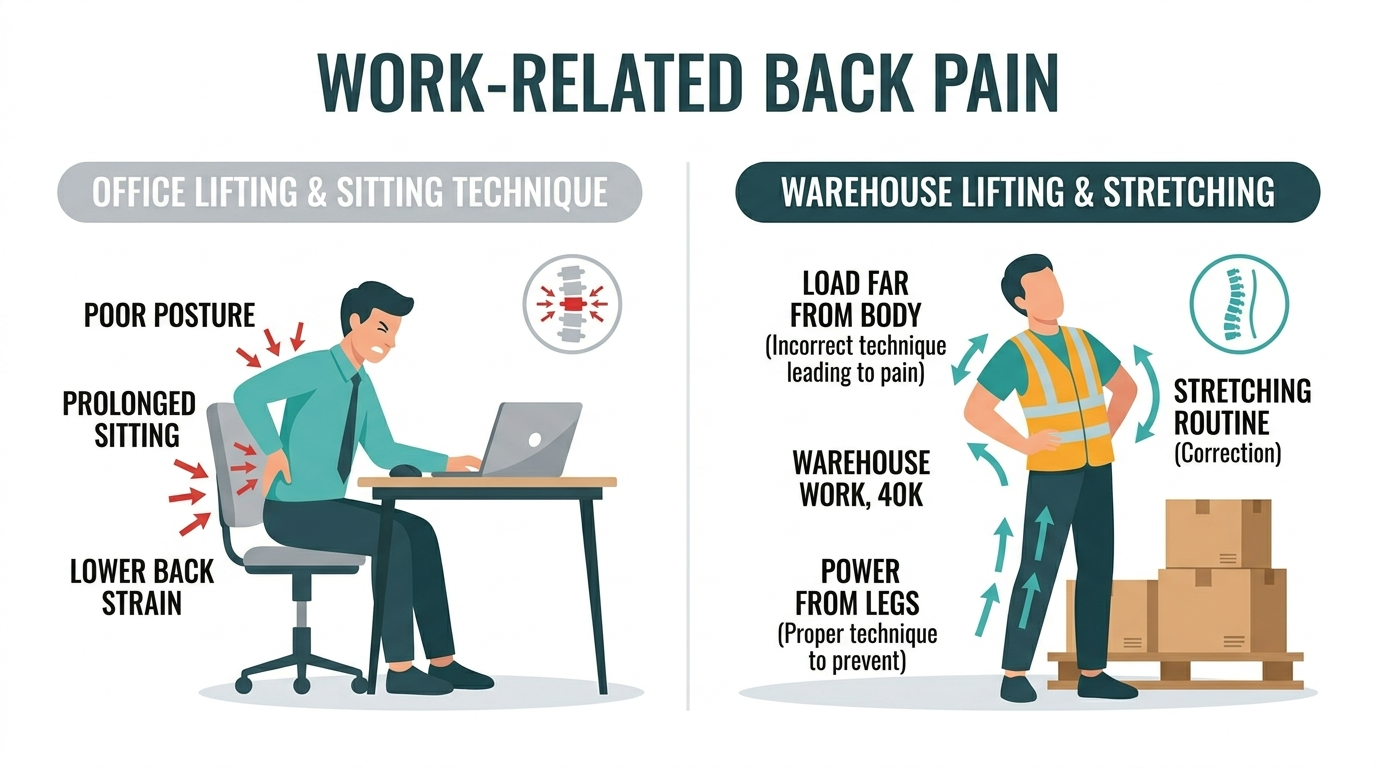
Morning one. You sit down at your desk at 8:30. You open your laptop. By 10:30, your lower back is aching. By lunch, you’re shifting in your chair every five minutes. By 3 p.m., you’re standing up at your desk because sitting hurts. You leave work at 5, your back is stiff and sore, and you tell yourself you need to find a better chair.
Morning two. You’re on a warehouse floor at 6 a.m. You’re loading pallets, moving inventory, bending and lifting for eight hours straight. By mid-afternoon, your lower back feels like it’s made of concrete. You get home, collapse on the couch, and wonder how long you can keep doing this before something gives.
Two completely different jobs. Same result.
Work-related back pain is one of the most common occupational health problems in Canada. Repetitive strain injuries account for over 30% of lost-time claims according to Ontario’s Workplace Safety and Insurance Board. And almost 45% of Canadians with chronic back pain report limitations in their daily activities because of it.
Here in Surrey, we see both types at Surge Wellness every week. The desk workers with creeping postural pain. The tradespeople and warehouse workers with acute lifting injuries. And everyone in between. Teachers who stand all day. Nurses who lift and twist. Construction workers. Delivery drivers.
The truth is, most work-related back pain is preventable. Not all of it. But way more than people think. And the strategies for preventing it are different depending on what kind of work you do. So let’s break this into two halves and get specific.
Part 1: If You Sit at a Desk All Day
I know you’ve heard the phrase "sitting is the new smoking." It’s a bit dramatic, but the underlying point is real. Prolonged sitting puts sustained compressive load on your lumbar discs, shortens your hip flexors, deactivates your glutes, and gradually reshapes your posture into something your spine really doesn’t enjoy.
The result is the slow-burning back pain that most desk workers know too well. It’s not a dramatic injury. It’s a gradual breakdown that creeps up over months and years.
Here’s how to fight it.
1. Fix Your Workstation Setup
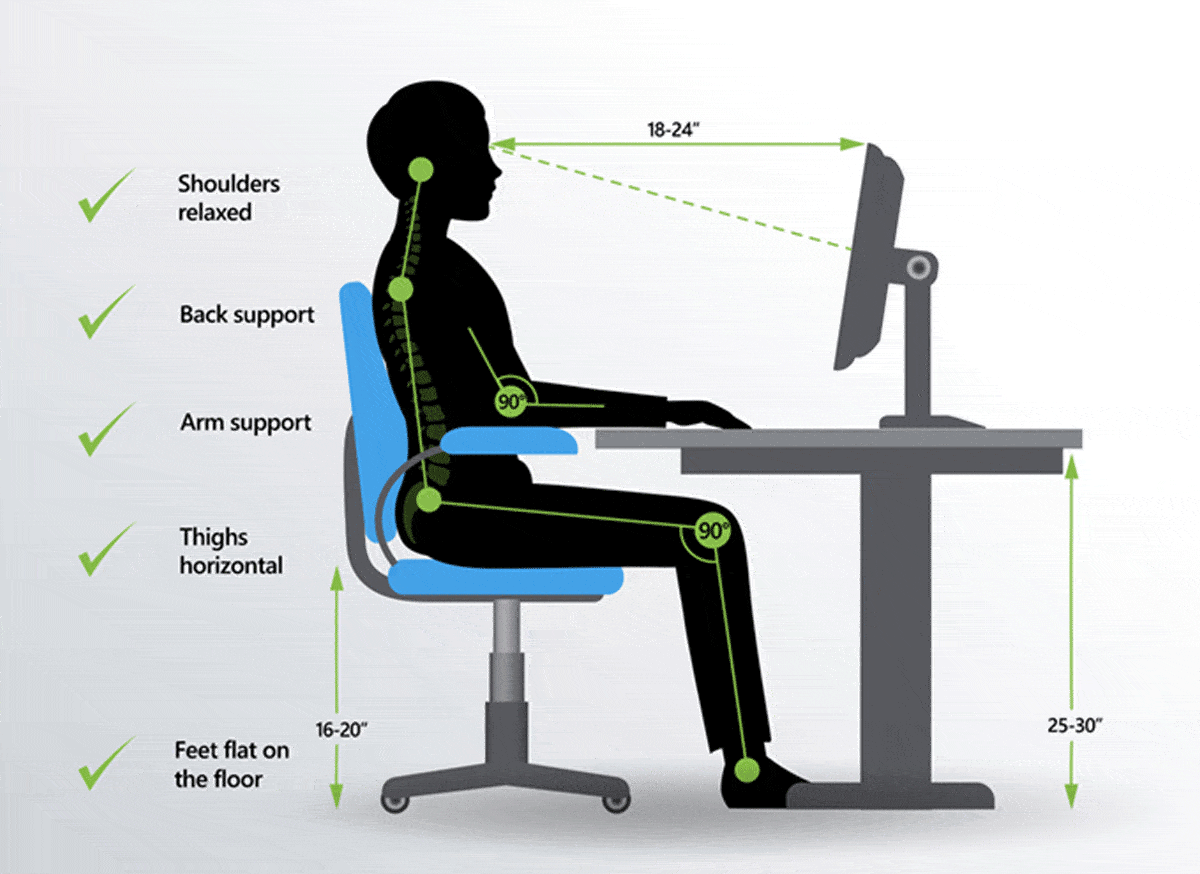
Your monitor should be at eye level, directly in front of you, about an arm’s length away. Your keyboard and mouse should be at elbow height so your shoulders can relax. Your feet should be flat on the floor. And your chair should support the natural curve of your lower back. If you’re working on a laptop without a separate monitor and keyboard, you’re almost certainly working in a posture that’s loading your spine incorrectly.
I realise that sounds like basic advice. But I can’t tell you how many patients come in with back pain and, when we ask about their setup, describe something that would make an ergonomist cry.
2. Move Every 30 Minutes (Non-Negotiable)
It doesn’t have to be a workout. Stand up. Walk to the water cooler. Do two minutes of gentle stretches at your desk. The point isn’t the intensity of the movement. The point is breaking the static load. Your discs rely on movement to stay hydrated and healthy. When you sit still for hours, they compress and lose fluid, which reduces their ability to absorb shock.
Set a timer on your phone. Every 30 minutes, stand up and move. It’s the single most impactful habit change for desk-worker back health.
3. Strengthen Your Core and Glutes Outside of Work
Your desk is weakening these muscles every day. You need to fight back. A simple routine of planks, glute bridges, bird-dogs, and dead bugs, done three times a week for 15 to 20 minutes, can dramatically reduce your risk of developing chronic lower back pain. If you’re not sure where to start, one session with a physiotherapist can set you up with a personalised routine.
4. Get Regular Massage Therapy (Before the Pain Shows Up)
This is something most people only think about after they’re already hurt. But preventative RMT is one of the smartest investments a desk worker can make. A monthly or bi-monthly massage focused on your lower back, hips, and thoracic spine keeps the muscle tension from building up to the point where it starts causing problems.
Think of it like getting your car serviced. You don’t wait until the engine seizes. You change the oil regularly. Your body works the same way.
5. Consider a Standing Desk, But Use It Right
Standing desks are great in theory. But most people use them wrong. They stand in one position for hours, which creates its own problems. The goal is variation. Alternate between sitting and standing throughout the day. Aim for roughly 20 to 30 minutes in each position before switching. And if you’re standing, keep a small footrest nearby and alternate which foot you rest on it. That subtle weight shift reduces the static load on your lower back.
Part 2: If Your Job Involves Lifting, Bending, or Being On Your Feet
This section is for the warehouse workers, the tradespeople, the delivery drivers, the nurses, the retail workers, and everyone else whose job involves physical demand. Your risk profile for back pain is different from a desk worker’s, and so are the prevention strategies.
1. Learn to Lift With Your Legs (And Actually Do It)
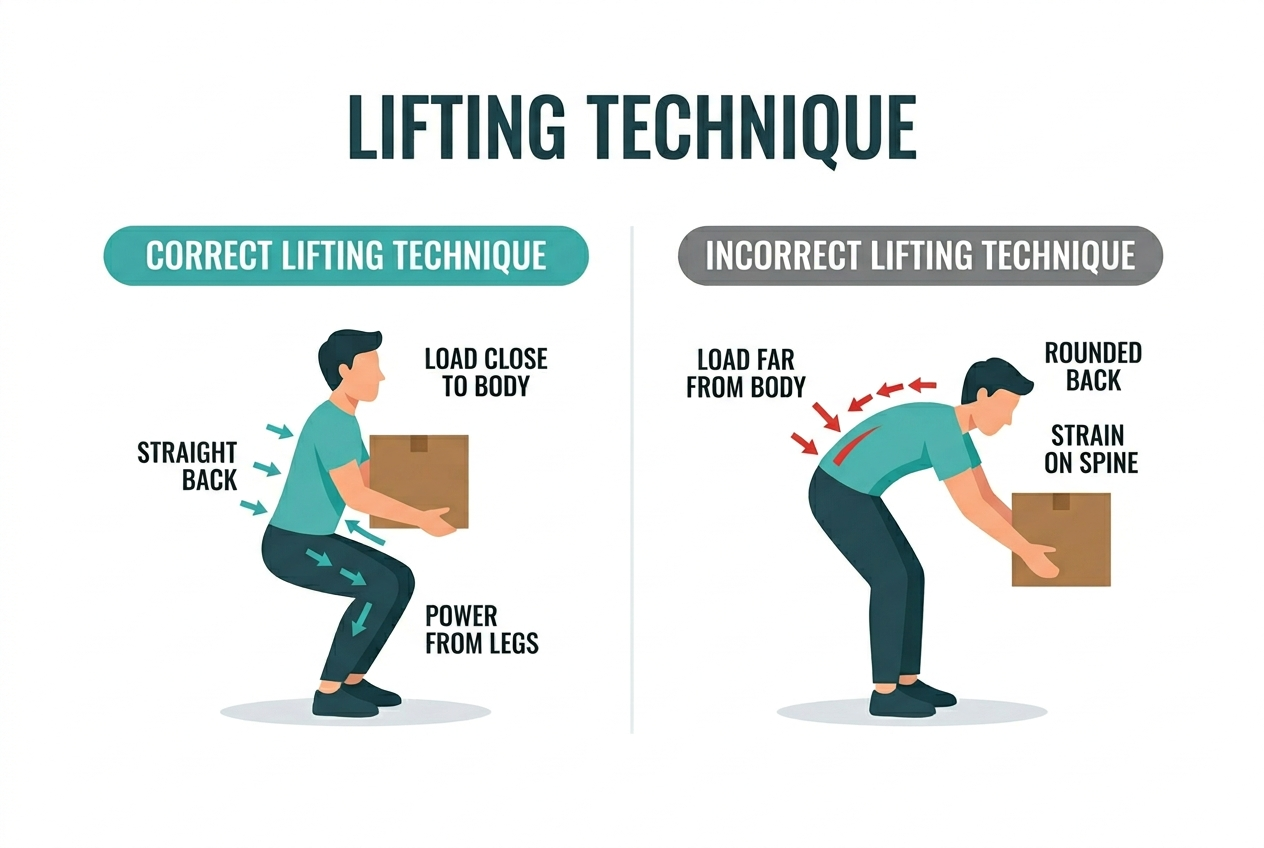
Everyone has heard "lift with your legs, not your back." But barely anyone consistently does it, especially when they’re tired, rushing, or handling an awkward load. Here’s the reality: every time you bend forward at the waist to pick something up, you’re putting enormous shear force on your lumbar discs. One wrong lift at the wrong angle can herniate a disc and put you out of work for weeks.
Squat down. Keep the load close to your body. Brace your core before you lift. And if the object is too heavy or awkward to lift safely alone, get help. Your back is not worth the extra 30 seconds.
2. Brace Before You Move
Your deep core muscles (transversus abdominis, multifidus) act like a natural weight belt for your spine. But they don’t activate automatically during every lift. You need to consciously engage them. Before you pick something up, push something heavy, or twist to move a load, take a breath in, tighten your core like someone’s about to poke you in the stomach, and then move. That bracing creates intra-abdominal pressure that stabilises your spine and protects your discs.
3. Rotate Tasks When Possible
Repetitive motion is one of the biggest risk factors for work-related back injuries. If your job involves the same bending, lifting, or twisting pattern over and over, talk to your supervisor about rotating tasks. Even switching between different physical activities throughout the shift gives your spine a break from the repetitive load. WorkSafeBC actually recommends task rotation as a primary prevention strategy for musculoskeletal injuries.
4. Don’t Skip the Warm-Up
If you’re going to spend eight hours doing physical work, your body needs a warm-up just like it would before a gym session. Five minutes of gentle movement, some hip circles, bodyweight squats, and cat-cow stretches before your shift starts can significantly reduce your injury risk. Your muscles and discs respond better to load when they’ve been primed with blood flow and gentle motion.
I know this sounds impractical on a busy warehouse floor. But five minutes at the start of a shift is a lot cheaper than six weeks off work with a herniated disc.
5. Invest in Recovery, Not Just Performance
Physical workers are often tough. They push through. They don’t complain. And that mental toughness is admirable, but it also means they tend to ignore early warning signs until something snaps.
Regular massage therapy and periodic physio check-ups aren’t luxuries. They’re tools that keep your body functional. A monthly RMT session to address the tension building up in your lower back and hips, combined with a physio consult every few months to check your movement patterns, can prevent the kind of acute injury that sidelines you for weeks.
Most extended health plans cover both RMT and physiotherapy, and we offer direct billing at Surge Wellness.
Prevention Tips That Apply to Everyone, Regardless of Job
Whether you’re behind a screen or behind a forklift, some prevention principles are universal. These apply across the board and are things we recommend to every patient at Surge Wellness who comes in with work-related back pain.
Stay Hydrated Throughout the Day
This sounds like one of those generic health tips that gets thrown into every article. But there’s a real reason it matters for your back specifically. Your intervertebral discs are largely made up of water. During the day, as you sit or stand and your spine bears load, those discs gradually lose fluid. Proper hydration helps them maintain their height and shock-absorbing ability. Dehydrated discs are stiffer, less resilient, and more prone to injury.
You don’t need to obsess over exact litres. Just keep a water bottle at your workstation and sip throughout the day. If your urine is pale yellow, you’re probably fine.
Don’t Smoke (Or Quit If You Do)
I know this seems unrelated to back pain, but the research is surprisingly strong on this one. Smoking reduces blood flow to the spinal discs, accelerates degenerative disc disease, and impairs the healing process after injury. Smokers are significantly more likely to develop chronic back problems and take longer to recover when they do get hurt. If you needed another reason to quit, your back is giving you one.
Sleep Matters More Than You Think
Your body does most of its tissue repair and recovery while you sleep. If you’re chronically getting five or six hours, your muscles, ligaments, and discs aren’t getting the recovery time they need. Poor sleep also amplifies pain sensitivity, meaning that the same injury will hurt more when you’re sleep-deprived. Aim for 7 to 8 hours. And if your back hurts at night, look at your mattress and pillow setup. A mattress that’s too soft or too firm, or a pillow that puts your neck at a bad angle, can undo all your daytime prevention efforts.
Manage Your Body Weight
I’ll say this carefully because I know it’s a sensitive topic. But carrying extra weight, particularly around the midsection, puts additional load on the lumbar spine. Research from the Canadian Community Health Survey found that higher BMI is a consistent risk factor for back problems. You don’t need to be a fitness model. Even modest weight management can meaningfully reduce the stress on your lower back.
Pay Attention to Early Warning Signs
This is maybe the most important one. Your back almost always gives you warning signs before a serious injury. Stiffness that used to go away by lunchtime but now lasts until evening. Mild achiness that shows up earlier and earlier in the week. A tightness that you notice is getting worse, not better.
Those are signals. Not something to push through. Not something to treat with more coffee and grit. They’re your body is telling you that something is building toward a bigger problem. A proactive appointment with a physiotherapist or RMT. at that stage can prevent weeks or months of pain down the road.
The Real Cost of Ignoring Work-Related Back Pain
Let’s talk about what happens when people don’t take prevention seriously. Because the costs are higher than most people realise.
Direct costs are the obvious ones: treatment, time off work, and potential surgery. In Canada, the total estimated cost of chronic pain is projected to exceed $50 billion annually, including direct healthcare costs and indirect costs from lost productivity. That’s a national figure, but every individual case contributes to it.
But the indirect costs are what really hit people. Lost income. Career limitations. Activities you can’t do with your kids. Sports you have to give up. Sleep, you’re not getting. The mental toll of living with persistent pain often leads to anxiety, depression, and social withdrawal.
I’ve watched patients go from being active, engaged people to barely being able to sit through dinner with their family. And in almost every case, they’ll tell you the same thing: "It started as something small at work that I ignored."
Prevention isn’t glamorous. It’s not exciting. But it’s infinitely cheaper and easier than recovery. And it keeps you in the life you want to be living, not on the sidelines watching it go by.
When Prevention Wasn’t Enough: What to Do If You’re Already Hurt
Sometimes, despite your best efforts, you get hurt at work. It happens. A weird twist, a heavy lift, a slip on a wet floor. If you’re dealing with a work-related back injury in BC, here’s what you need to know.
WorkSafeBC Claims
If your back injury happened on the job, you may be eligible for WorkSafeBC coverage. This can cover physiotherapy, massage therapy, and other rehabilitation costs. Report the injury to your employer as soon as possible and file a claim with WorkSafeBC. At Surge Wellness, we’re familiar with the WorkSafeBC process and can help you navigate it.
Don’t Wait to Get Assessed
The same principle applies here as it does with every other type of back pain: early treatment leads to better outcomes. A work injury that gets assessed and treated within the first week recovers faster than one that’s ignored for a month. If you’re telling yourself, "it’ll go away," and it’s been more than a few days, book an appointment
Your Employer Has Obligations Too
Under BC law, your employer is required to provide a safe working environment and to accommodate return-to-work plans after an injury. A physiotherapist can help by providing documentation of your functional limitations and recommendations for modified duties during recovery. This protects both you and your employer.
The Long Game: Building a Back That Can Handle Your Job
Prevention isn’t just about avoiding the big injury. It’s about building resilience over time so your back can handle what your job throws at it, year after year.
That means:
Consistent core and glute strength training, whether you sit or lift for work
Regular mobility work for your hips and thoracic spine
Periodic RMT sessions to manage the tension that accumulates from repetitive work patterns
Annual or semi-annual physio assessments to catch movement dysfunction before it becomes pain
Paying attention to early warning signs (stiffness, achiness, tightness) instead of waiting for a crisis
The people who take this approach don’t end up on our table with acute injuries very often. And when they do, they recover fast because their body has the baseline strength and flexibility to bounce back. That’s the goal.
Frequently Asked Questions
Is back pain from work covered by WorkSafeBC?
If the injury happened at work or is directly related to your work duties, it may be covered by WorkSafeBC. You’ll need to report the injury to your employer and file a claim. At Surge Wellness, we can help guide you through the process and direct bill for approved claims.
How often should I get massage therapy if I have a physically demanding job?
For prevention, once or twice a month is a good baseline. If you’re already experiencing regular tightness or early-stage pain, weekly sessions for a period can help get things under control before they escalate. Your RMT will recommend a schedule based on your specific needs.
Can a physiotherapist help me set up my desk properly?
Absolutely. Ergonomic assessment and advice is part of what physiotherapists do. One session is usually enough to identify the problems in your setup and give you practical solutions. It’s one of the most cost-effective things you can do for long-term back health.
I’ve had back pain from work for years. Is it too late to fix it?
No. It’s never too late to improve. Long-standing back pain does take more time and effort to resolve, but with the right combination of RMT and physiotherapy, significant improvement is absolutely possible. We’ve treated patients with 10+ years of work-related back pain who’ve gotten dramatically better. The key is consistency and the right treatment plan.
Does Surge Wellness direct bill my extended health insurance?
Yes. We offer direct billing for most major extended health plans in BC, as well as ICBC and WorkSafeBC claims. Check with our front desk if you’re unsure about your specific plan.
What’s the best exercise to prevent back pain at work?
There’s no single magic exercise, but if I had to pick one, it would be the glute bridge. It strengthens your glutes, activates your core, and counteracts the sitting posture that most people spend too much time in. Do 3 sets of 12 to 15, three times a week. Your back will thank you. If you want a full routine tailored to your job, book one session with our physio team, and we’ll set you up.
Your Back Shouldn’t Be the Price You Pay for Going to Work
Whether you spend your days at a desk or on a warehouse floor, your back doesn’t have to suffer for it. At Surge Wellness in Surrey, BC, we help people prevent work-related back pain and recover from it when prevention isn’t enough.
RMT, physiotherapy, or both. We’ll figure out what you need and build a plan that actually fits your work life.
→ Book Your Appointment at Surge Wellness
Call us, book online, or walk in. Let’s keep your back in the game.